Atterberg Limits Laboratory Tests
Liquid limit
The liquid limit test, defined in ASTM Standard D4318, determines the water content at which the behavior of a clayey soil changes from plastic to liquid. However, the transition from plastic to liquid behavior is gradual over a range of water contents, and the shear strength of the soil is not actually zero at the liquid limit. The precise definition of the liquid limit is based on standard test procedures. Liquid Limit can be determined using the Casagrande cup method, which is widely used in the United States or with a cone penetrometer, which is more prevalent in Europe.
Liquid limit
The liquid limit test, defined in ASTM Standard D4318, determines the water content at which the behavior of a clayey soil changes from plastic to liquid. However, the transition from plastic to liquid behavior is gradual over a range of water contents, and the shear strength of the soil is not actually zero at the liquid limit. The precise definition of the liquid limit is based on standard test procedures. Liquid Limit can be determined using the Casagrande cup method, which is widely used in the United States or with a cone penetrometer, which is more prevalent in Europe.
Plastic limit
Plastic limit is a test that involves rolling out a thread of the fine portion of a soil on a flat, non-porous surface. The procedure is defined in ASTM Standard D4318. If the soil is at a moisture content where its behavior is plastic, this thread will retain its shape down to a very narrow diameter. The sample can then be remolded and the test repeated. As the moisture content falls due to evaporation, the thread will begin to break apart at larger diameters. The plastic limit is defined as the moisture content where the thread breaks apart at a diameter of 3.2 mm (about 1/8 inch). A soil is considered non-plastic if a thread cannot be rolled out down to 3.2 mm at any moisture possible.
Plastic limit is a test that involves rolling out a thread of the fine portion of a soil on a flat, non-porous surface. The procedure is defined in ASTM Standard D4318. If the soil is at a moisture content where its behavior is plastic, this thread will retain its shape down to a very narrow diameter. The sample can then be remolded and the test repeated. As the moisture content falls due to evaporation, the thread will begin to break apart at larger diameters. The plastic limit is defined as the moisture content where the thread breaks apart at a diameter of 3.2 mm (about 1/8 inch). A soil is considered non-plastic if a thread cannot be rolled out down to 3.2 mm at any moisture possible.
Shrinkage limit
Shrinkage limit is a test that evaluates the water content of a soil where further loss of moisture will not result in an additional volume reduction. The test to determine the shrinkage limit is ASTM D4943. The shrinkage limit is much less commonly used than the liquid and plastic limits.
Shrinkage limit is a test that evaluates the water content of a soil where further loss of moisture will not result in an additional volume reduction. The test to determine the shrinkage limit is ASTM D4943. The shrinkage limit is much less commonly used than the liquid and plastic limits.
A: Liquid Limit Test of Soil
Liquid Limit Testing Tools
The consistency and behavior of soils vary throughout. Therefore, qualities such as moisture content, hardness and reliability are important to test within specimens in order to assure stability in the structures they support. To assess these characteristics, Atterberg limit tests are done often to measure water content within on-site soil.
One way to measure the critical water content of fine-grained soil is through its liquid limit. Liquid limit is defined as the water content at which the behavior of clayey soil changes from plastic to liquid. Using ASTM Standard D4318, the liquid limit test of soil determines this transition over a range of water contents. More specifically, it gives valuable information regarding the state of consistency of soil on-site.
A liquid limit test of soil can be determined using two methods:
- The Casagrande cup method, which is widely used in the United States, defines liquid limit as the moisture content required to close a metal cup filled with soil paste a distance of 0.5 inches using a liquid limit machine. This method is normally run at several moisture contents to determine which requires 25 blows to close the groove.
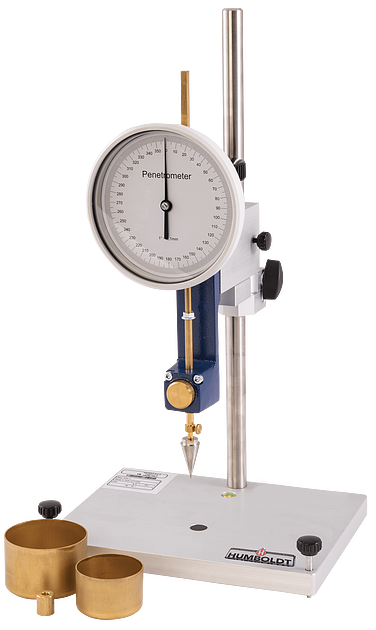
- The cone penetration test for liquid limit is more prevalent in Europe and measures the moisture content at which a cone will penetrate a soil sample a distance of 20 mm in approximately 5 seconds. This less is less dependent on the operator when determining a soil’s liquid limit.
In each testing type, many data points are collected and used to plot a flow curve which ultimately establishes a liquid limit. To ensure an accurate curve, high-quality equipment must be used in these tests. These liquid limit machines and accessories should follow ASTM standards and produce error-free results time and time again.